Computational Thinking in Education
Relevance to 21st Century Education
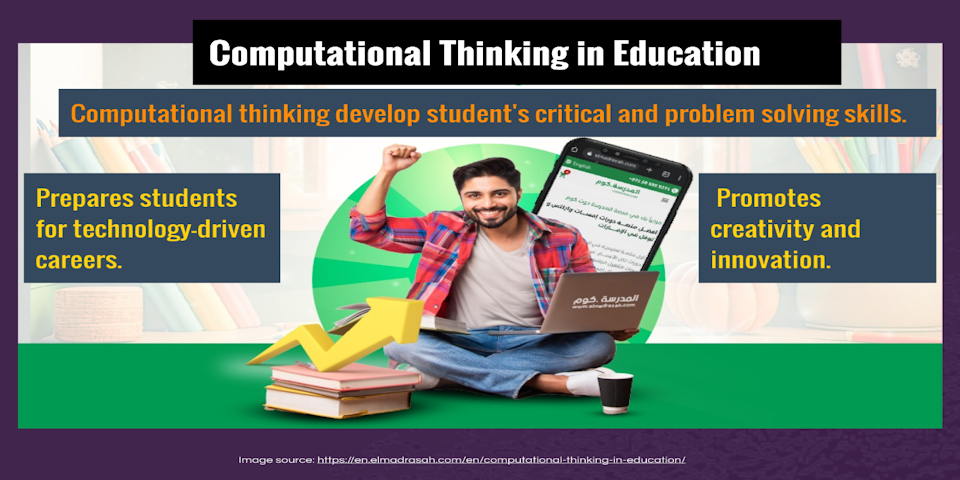
In a technology-driven world, computational thinking skills are essential for students to navigate and address complex problems, and educators aim to equip students with critical 21st-century skills (Wong & Cheung, 2020). Integrating computational thinking into education extends beyond coding, fostering systematic thinking and adaptability (Varela et al., 2019).
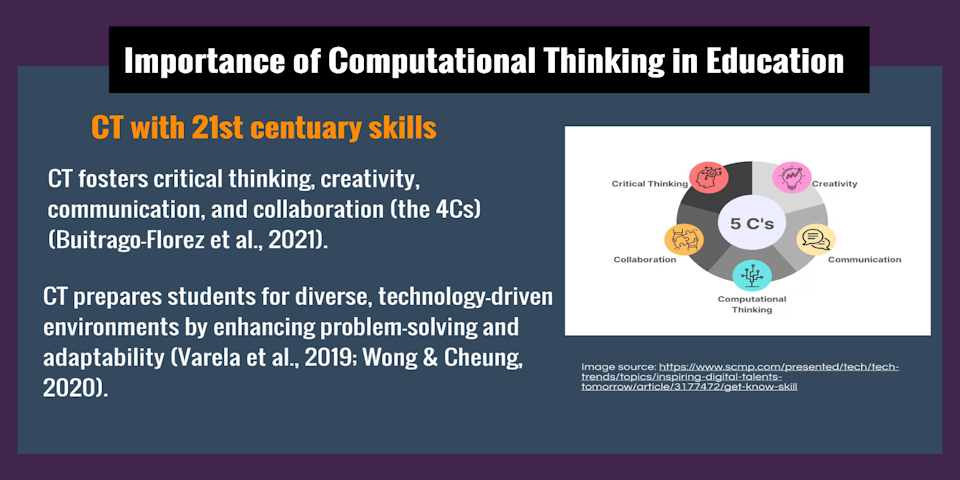
Through a computational thinking focused curriculum, teachers can support students in developing skills that apply across disciplines, preparing them for high-tech fields and enhancing adaptability and collaborative abilities in diverse contexts (Haseski et al., 2018). computational thinking aligns with the 4Cs—critical thinking, creativity, communication, and collaboration—highlighting its importance in fostering dynamic, innovative learning environments suited for today’s complexities (Buitrago-Florez et al., 2021).
CT’s 21st-century relevance extends seamlessly across disciplines, empowering students to deepen their learning experiences and preparing them for future challenges.
Relevance to Cross-Disciplinary Education
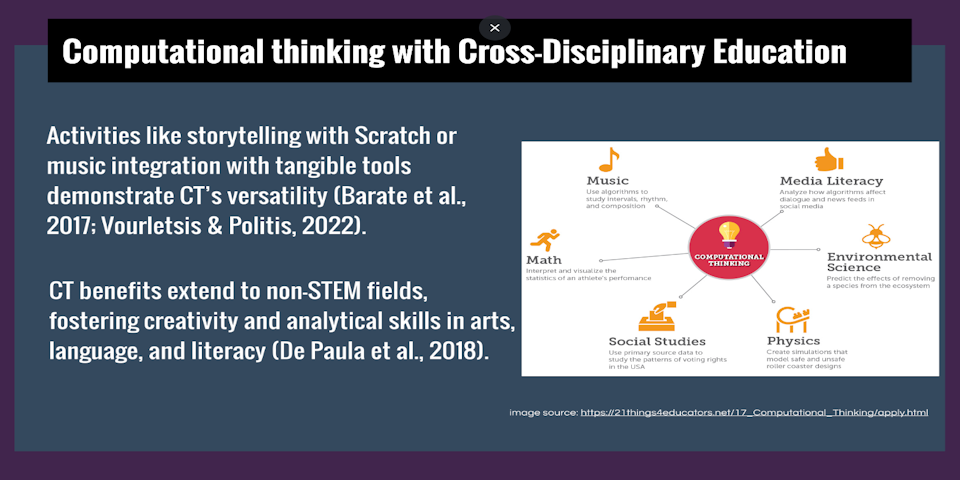
Integrating computational thinking across disciplines connects educational practices with real-world challenges and creates dynamic learning environments (Peel et al., 2022). While computational thinking is prominent in STEM education for enhancing problem-solving, critical thinking, and creativity (Beheshti et al., 2017; Smith et al., 2018; Markandan et al., 2022), its benefits extend beyond STEM.
Research shows computational thinking 's value in arts, language, and literacy by fostering creativity, narrative skills, and analytical thinking (De Paula et al., 2018). For instance, remixing digital content with Scratch (a programming tool), especially through collaborative activities in games and storytelling, enhances students' skills and fosters deeper learning through social engagement (Vourletsis & Politis, 2022).
Combining music and computational thinking through tangible activities like LEGO effectively introduces computational thinking concepts to young learners, promoting problem-solving and abstract thinking skills (Barate et al., 2017). Incorporating computational thinking into language learning facilitates deeper cognitive engagement and encourages students to approach linguistic challenges with computational strategies (Yu et al., 2024).
computational thinking is a flexible cognitive tool that fosters critical thinking, creativity, and problem-solving, preparing skilled thinkers for 21st-century challenges (Robledo-Castro et al., 2023). By introducing computational thinking early in education, students develop essential skills for navigating the complexities of the digital world.