Challenges in Implementing Computational Thinking
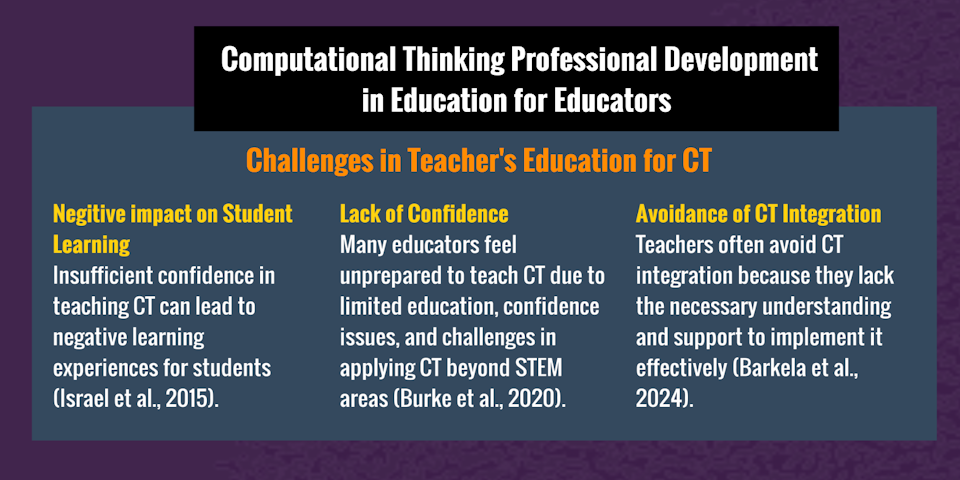
Despite the growing emphasis on computational thinking, many educators feel unprepared to teach it (Sentance & Csizmadia, 2017). Barriers include a lack of confidence, limited education, and perceived difficulty in applying computational thinking outside STEM fields (Burke et al., 2020). Many teachers avoid integrating computational thinking due to a lack of understanding and insufficient institutional support (Barkela et al., 2024).
However, when teachers lack confidence in teaching computational thinking effectively, students may encounter negative learning experiences with the concept (Israel et al., 2015).
Empowering Educators to Teach Computational Thinking
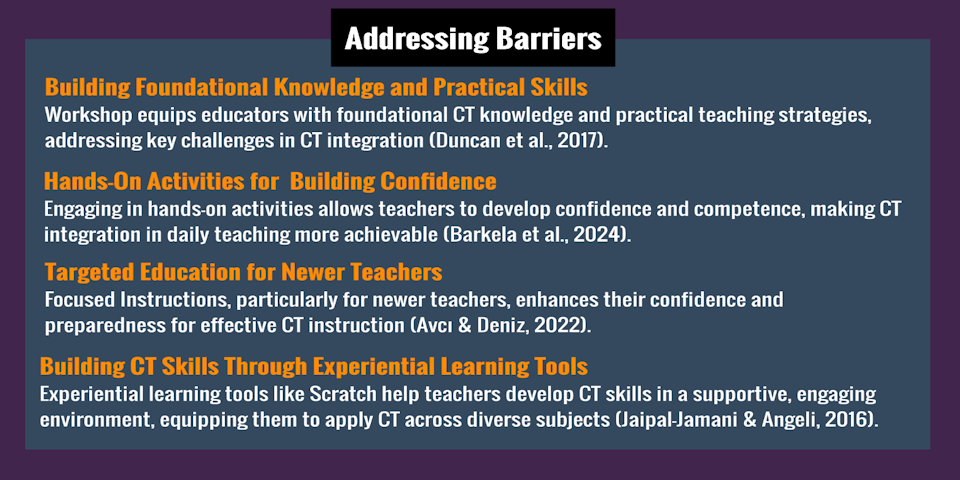
My designed workshop addresses these challenges by providing educators with a foundational knowledge of computational thinking, practical teaching strategies, and opportunities for collaborative problem-solving (Duncan et al., 2017). By participating in hands-on activities, teachers will build their confidence and competence, making incorporating computational thinking into everyday teaching more accessible (Barkela et al., 2024).
Targeted education, especially for newer teachers, builds teachers’ confidence and readiness for computational thinking instruction (Avcı & Deniz, 2022). Additionally, experiential learning tools like Scratch help teachers develop computational thinking skills in a supportive, engaging environment, equipping them to apply computational thinking across diverse subjects (Jaipal-Jamani & Angeli, 2016).
Why Computational Thinking Professional Development Works
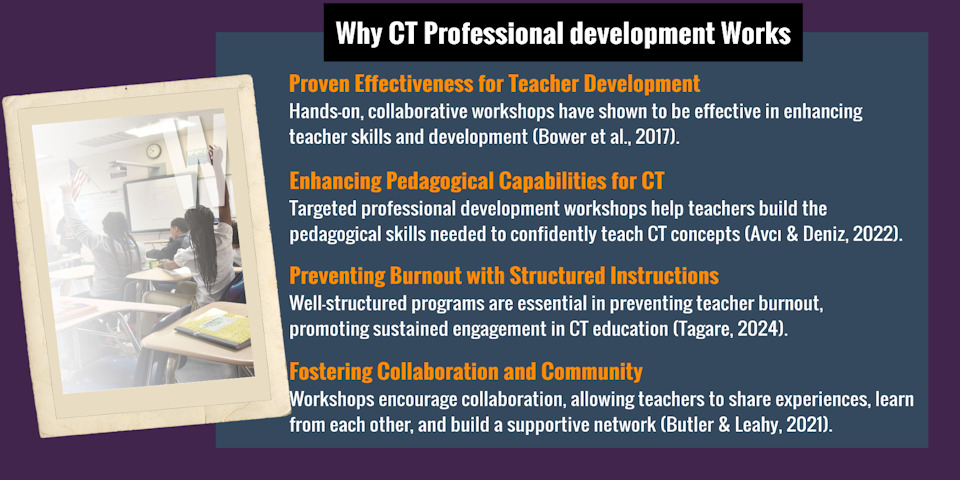
Hands-on, collaborative workshops have proven effective for teacher development (Bower et al., 2017). Targeted professional development enhances teachers' ability to integrate computational thinking concepts confidently and effectively into their classrooms (Avcı & Deniz, 2022).
By participating in activities such as designing algorithms or solving unplugged logic puzzles, teachers develop practical skills and strategies to engage students. This approach prevents burnout by setting clear, achievable goals and providing ongoing support (Tagare, 2024).
Workshops also offer a collaborative learning environment, allowing educators to share experiences, exchange ideas, and build a community of practice (Butler & Leahy, 2021). These workshops empower teachers to demystify computational thinking, making it relevant and applicable across subjects, and prepare students with critical problem-solving skills for a technology-driven world (Bower et al., 2017; Caeli & Yadav, 2019).
Collaborative Lesson Design
This workshop adopts a similar approach, encouraging teachers to collaborate on designing computational thinking integrated lesson plans and activities. By learning in a supportive, collaborative setting, teachers are more likely to feel confident in their ability to teach computational thinking and are better equipped to foster these skills in their students.
Conclusion
Overall, teacher education is essential for successfully integrating computational thinking into educational curricula. By addressing confidence-related challenges, providing tools for cross-disciplinary integration, and using hands-on, collaborative workshops, educators can develop the skills and confidence needed to bring computational thinking into their classrooms.
This approach prepares teachers to teach computational thinking effectively and empowers students to become adept problem-solvers and critical thinkers with the skills they need to succeed in a technology-driven world.